
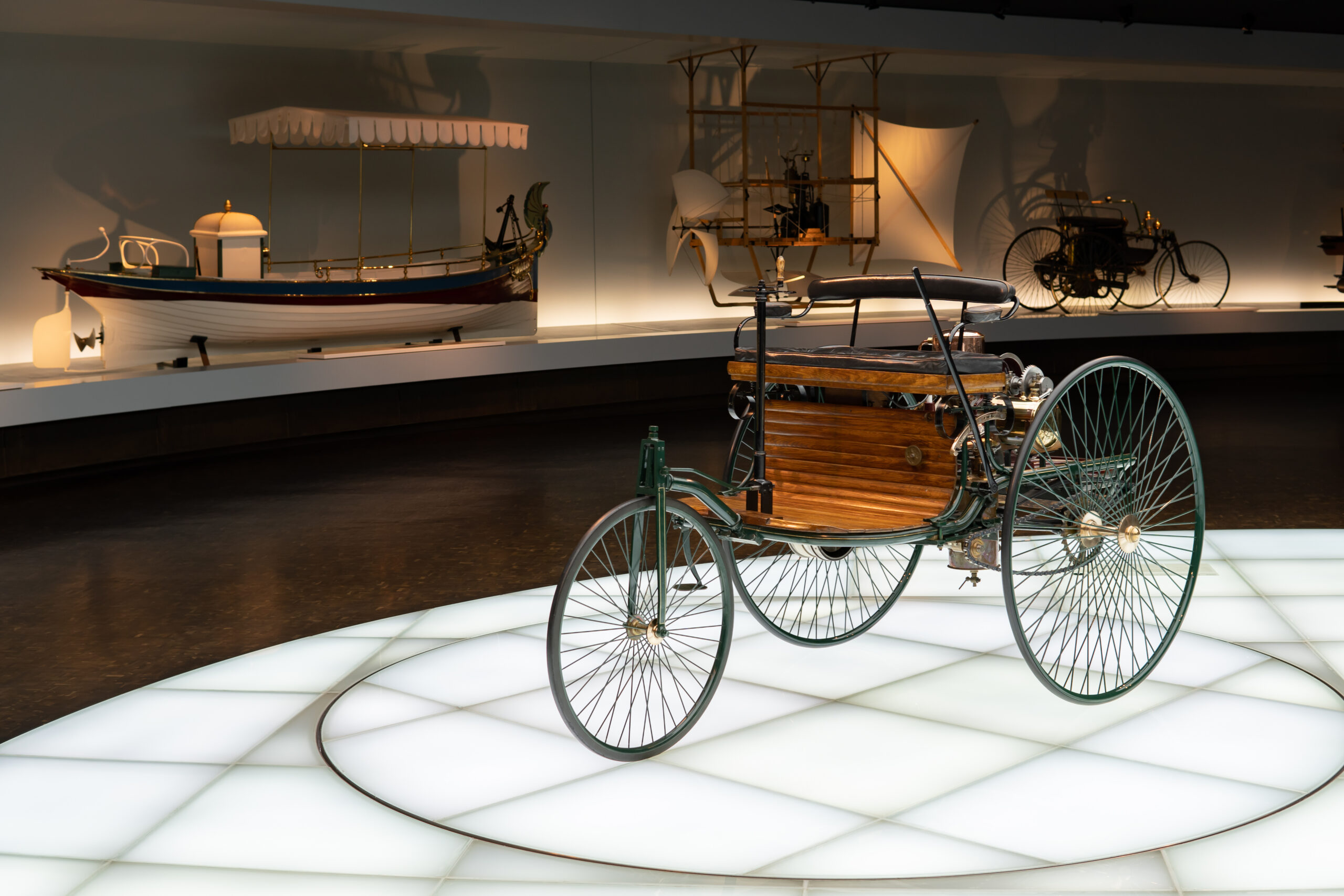
On July 3, 1886, a revolutionary invention made its public debut when Karl Benz officially unveiled the Benz Patent-Motorwagen in Mannheim. Widely regarded as the world’s first purpose-built automobile powered by an internal combustion engine, the three-wheeled Motorwagen marked the beginning of a transportation revolution that would forever change how people traveled, worked, and lived.
Although few spectators could have imagined its future impact, the Benz Patent-Motorwagen laid the foundation for the modern automobile industry and transformed personal transportation across the globe.
Transportation Before the Automobile
In the late 19th century, most people relied on horses, horse-drawn carriages, bicycles, or trains to travel. While railroads connected cities, everyday transportation remained slow and limited.
Inventors had experimented with steam-powered vehicles and other mechanical designs for decades, but these machines were often bulky, unreliable, and impractical for regular use.
Karl Benz believed there was a better solution. Rather than adapting an existing carriage, he designed a vehicle specifically to be powered by a gasoline engine—a bold concept that set his invention apart from everything that came before it.
A Revolutionary Design
The Benz Patent-Motorwagen looked very different from today’s automobiles. It rode on three wire-spoke wheels instead of four and featured a lightweight steel frame, large rear wheels, and a single front wheel used for steering.
At its heart was a compact, single-cylinder, four-stroke gasoline engine mounted at the rear of the vehicle. The engine produced less than one horsepower, but that was enough to propel the lightweight machine at speeds approaching 10 miles per hour (16 kilometers per hour).
For its time, the Motorwagen included several groundbreaking innovations:
- A gasoline-powered internal combustion engine
- An electric ignition system
- Water cooling for the engine
- A simple transmission system
- Hand-operated steering and braking mechanisms
These features demonstrated that self-propelled personal transportation was not only possible but practical.
Public Reaction
When Karl Benz unveiled the Motorwagen in July 1886, reactions were mixed. Some observers viewed the machine with curiosity and excitement, while others were skeptical that a “horseless carriage” could ever replace traditional transportation.
The noisy engine, unusual appearance, and unfamiliar technology made the vehicle seem almost unbelievable to many people. Yet Benz remained confident that the automobile represented the future.
Although early sales were modest, the invention attracted growing interest from engineers, entrepreneurs, and investors eager to explore its possibilities.
Bertha Benz Proves the Automobile’s Potential
One of the most important moments in the Motorwagen’s history came two years later, when Karl’s wife, Bertha Benz, undertook the world’s first long-distance automobile journey.
Without informing her husband, she drove the Patent-Motorwagen approximately 66 miles (106 kilometers) from Mannheim to Pforzheim to visit her family.
Along the way, she solved mechanical problems, purchased fuel from a pharmacy, and demonstrated that the automobile could successfully handle real-world travel.
Her journey generated widespread publicity and convinced many skeptics that the new invention had enormous potential.
The Birth of the Automotive Industry
The success of the Patent-Motorwagen inspired further innovation. Karl Benz continued improving his designs, while other inventors and manufacturers entered the emerging automobile industry.
Before long:
- Vehicles became faster and more reliable.
- Four-wheel designs replaced many three-wheel models.
- Mass production made automobiles affordable for ordinary families.
- Roads, highways, and fueling stations expanded to support growing numbers of drivers.
The automobile transformed commerce, tourism, urban planning, and daily life in ways few could have predicted in 1886.
A Legacy That Continues Today
Modern cars bear little resemblance to the original Benz Patent-Motorwagen, yet every automobile on the road today traces part of its heritage to Karl Benz’s pioneering invention.
The unveiling of the Motorwagen on July 3, 1886, marked the beginning of a new era of mobility. It sparked an industry that now produces millions of vehicles each year and connects communities across the world.
More than a century later, Karl Benz’s vision continues to shape transportation, proving that one innovative idea can change the course of history. What began as an unusual three-wheeled machine on the streets of Mannheim became the starting point for the modern automobile—a revolution that continues to drive the world forward.